Why this matters
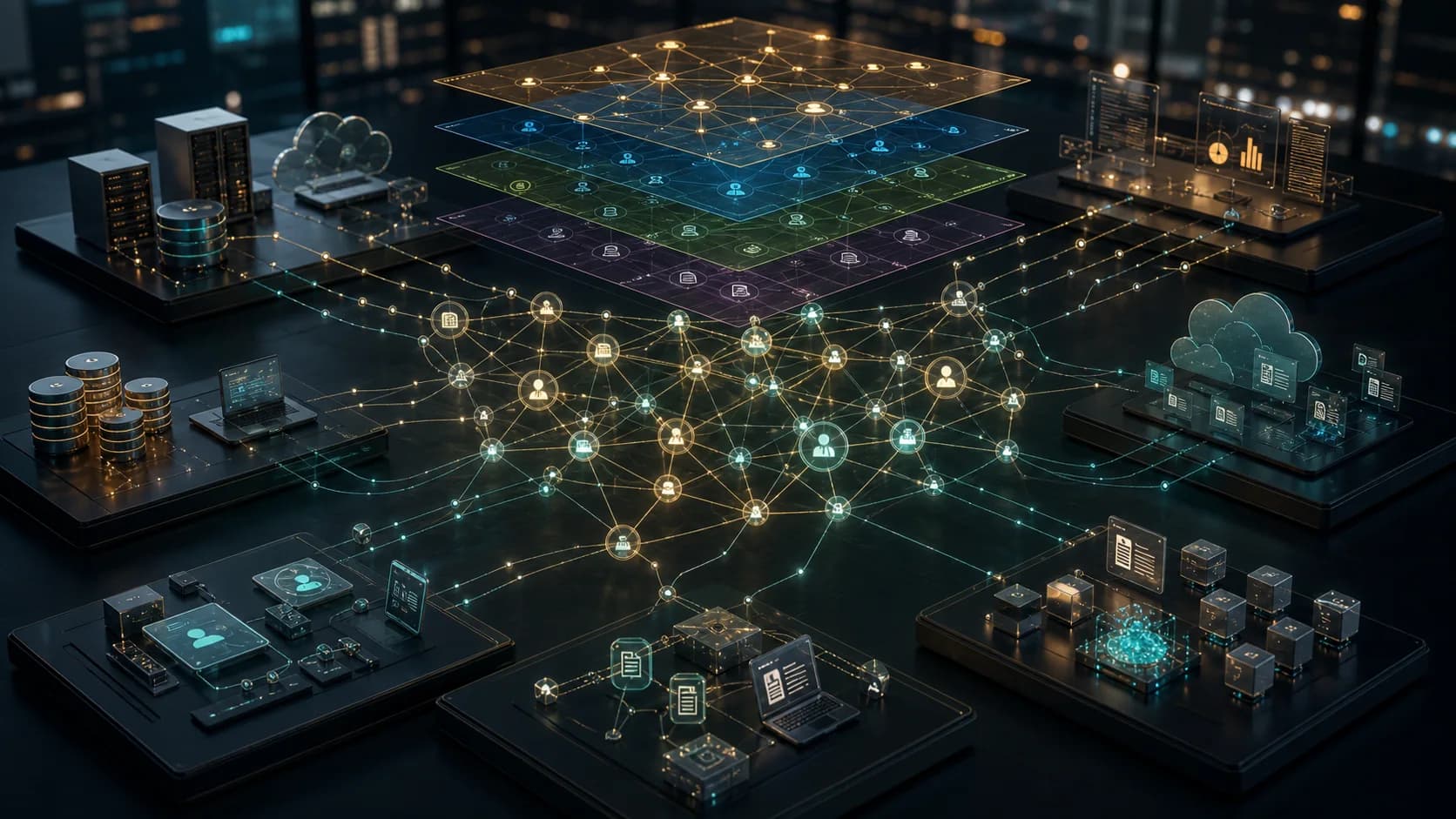
Organizations sit on data spread across customer systems, resource planning, data lakes and software services. Each stores it in tables shaped for one application. Knowledge graph infrastructure treats the relationships between data as the point, and builds a web of meaning that spans systems, departments and use cases. The same web is what AI agents now retrieve from.
What it is
Knowledge graph infrastructure is the stack used to build, store, query and govern networks of connected data. More than one database, it covers:
- Graph storage. An engine that keeps nodes, edges and properties in a form built for following relationships rather than scanning rows.
- A semantic layer. Ontologies and schemas that define the kinds of things and the relationships allowed between them: the grammar that lets every team speak the same data language.
- Query languages. SPARQL, Cypher and GQL, which let people and models ask multi-hop questions across the whole graph.
- Ingestion. Tooling that pulls data from its sources, maps it into the graph and keeps it current.
- Security and governance. Encryption, access control, audit and provenance, which make the graph fit for real work.
How it works
A knowledge graph represents information as entities, such as people, products, transactions and documents, connected by typed relationships: reports to, contains, purchased, authored. That is how domain experts already think about their data, as a web of context rather than a set of flat tables.
When a person or an agent asks the graph a question, the engine walks the relationships to assemble an answer that a traditional system would need joins, denormalization and guesswork to produce. For example:
Show me every supplier whose components appear in products that failed quality checks in the last ninety days, and flag the ones that also supply our top customers.
In a relational database that is a chain of joins across isolated tables, hand-written and brittle. In a graph it is one query that follows relationships already in the data.
How mature it is
Representing knowledge as a graph is decades old, from semantic networks in the 1960s to the RDF standard in 1999 and web-scale knowledge graphs in the 2010s. Enterprise graph databases have run in production for more than ten years.
What is new is three trends meeting:
- AI needs structured retrieval. Language models drift when they work from loose text alone. A graph gives them verified, structured facts to work from, and reasoning that says what those facts imply.
- Data mesh and federation. Organizations move from one central warehouse to domain-owned data products. A graph connects the domains without forcing them into one database.
- Provenance questions. Reviews of data and AI decisions ask for lineage, provenance and auditability. Graph infrastructure can make them intrinsic rather than bolted on.
What it gives you
Fewer silos. One queryable fabric across sales, people, finance and engineering, without moving everyone to the same database.
Grounded AI. The graph becomes the retrieval layer for agents: structured facts with provenance, not passages that may or may not be current.
Room to grow. A graph takes new entity types, properties and relationships without forcing every domain into one canonical model. Existing queries still need stewardship, but the graph carries several viewpoints at once.
Patterns in the connections. Fraud, supply chain risk, compliance, talent and drug interactions are all questions about links. Graphs answer them directly.
Operational answers. Recommendation, identity resolution, network monitoring and impact analysis all run as graph queries over connected systems.
What it costs
Skills. Graph query languages are less known than SQL. Teams need training or tooling that hides the query layer.
Modeling. Building the ontology takes domain experts and data architects working together up front. The return is high and so is the first investment.
Integration. Connecting relational databases, APIs and streams needs pipelines that map source schemas into the graph.
A split market. RDF and SPARQL on one side, property graphs and Cypher on the other. Choosing one has usually meant giving up the other's strengths.
Scale. Not every engine handles billions of edges well. Distribution, indexing and caching decide it.
What to ask
Which query languages? Does it speak the languages your team knows? Does it bridge RDF and property graphs?
How is integrity kept? Are there cryptographic checks that data has not been altered, or do you trust the operator?
Is there history? Can you branch, merge and read the graph as it was? Or does every write destroy what came before? Legra's answer is history.
Who holds the keys? Is encryption end to end, or can the operator read your data?
How is it distributed? Can it run in several places, work offline and synchronize without a central server?
Is it ready for agents? Can an agent retrieve from it, and work on it, under the same rules as people?
Try it in Legra
The Legra quickstart walks through loading a small graph and querying it, with expected results you can check.